How to Price Christmas Light Installation: Per Foot, Per House, and the Hidden Costs
Set your Christmas light installation price from your own costs: a per-foot formula, job minimums, per-house packages and the hidden costs that eat margin.
On this page
To price Christmas light installation, add up your true cost per foot (lights, clips, install and takedown labour, fuel, storage and a callback reserve), add your share of overhead, then divide by one minus your target margin. Use that per-foot rate for rooflines, price trees, wreaths and ground work per piece, and protect small jobs with a minimum. The rest of this guide walks through each step with worked examples you can replace with your own numbers.
Start with your cost, not a competitor's price per foot
The most common pricing mistake in this trade is copying a competitor's per-foot number. You don't know their crew wage, whether they sell or lease the lights, how far they drive, or whether they're making money at all.
Your price has to come from three things only you know:
- Your direct cost per foot: everything it takes to put up, maintain and take down one foot of lights.
- Your overhead: the yearly costs that exist whether you hang one house or three hundred.
- Your target margin: what you want left after both.
Once you have those, a competitor's rate is useful only as a sanity check on how you present your price, not as the price itself.
How to price Christmas light installation per foot
Per-foot pricing works because rooflines are the bulk of most residential jobs and footage is easy to explain to a homeowner. Build the rate one cost line at a time.
The table below is an example for a lease-style job (you own the lights and reuse them for several seasons) on a 200 ft roofline with a two-person crew. Swap in your own numbers.
| Cost line | How to calculate it | Example per foot |
|---|---|---|
| C9 bulbs, wire and sockets | Purchase cost per foot divided by the seasons you expect to reuse them ($1.20 over 3 seasons) | $0.40 |
| Clips and zip ties | Single-use, bought new every job | $0.08 |
| Install labour | 2 people x 3 hours x $32 loaded hourly cost, divided by 200 ft | $0.96 |
| Takedown labour | 2 people x 1.5 hours x $32, divided by 200 ft | $0.48 |
| Fuel and vehicle | Two round trips at $20 each, divided by 200 ft | $0.20 |
| Storage and labelling | Bins, shelf space and handling, spread per foot | $0.10 |
| Callback reserve | Money set aside for outages, wind damage and GFCI trips | $0.10 |
| Direct cost | $2.32 | |
| Overhead share | Example: $30,000 yearly overhead divided by 40,000 ft you expect to sell | $0.75 |
| All-in cost | $3.07 |
"Loaded hourly cost" means wage plus payroll taxes, workers' comp and any per-hour benefits. If you pay $22 an hour and forget the load, every job is underpriced before you leave the shop.
Turn cost into a price with your margin
Divide your all-in cost by (1 minus your target margin). This is margin, not markup: a 40% markup on cost is only about a 29% margin on the price.
| Example target margin | Formula | Example price per foot |
|---|---|---|
| 25% | $3.07 / 0.75 | $4.09 |
| 35% | $3.07 / 0.65 | $4.72 |
| 45% | $3.07 / 0.55 | $5.58 |
Round to a clean number you are comfortable saying out loud. Then check it against your schedule: if you can only install so many feet in a season, the margin per foot is what pays for your year.
The hidden costs that eat your margin
Most underpriced quotes aren't wrong on the obvious lines. They're missing the costs that show up after the sale.
- Bulb and socket replacement. Bulbs crack, sockets corrode and reels get damaged in storage. Budget a replacement percentage on top of the reuse math.
- Clips you never get back. Clips are rarely worth reusing at scale. Price them as a consumable on every job.
- Takedown. If takedown isn't in the price, you're doing it for free in January when you're tired and the roof is icy.
- Fuel and drive time. Two visits minimum per house, plus callbacks. Route density matters more than the per-foot rate on far-out jobs.
- Storage. Bins, labels, shelving and warehouse rent all have a cost per foot, even if the space is your garage.
- Insurance. General liability, workers' comp and commercial auto. Ladder and roof work can push premiums up, so get your real quote before you set prices.
- Callbacks. Every outage call costs a truck roll. A small reserve per foot keeps service calls from eating the profit on that house.
- Equipment. Ladders, harnesses, roof anchors, timers and extension cords wear out. Spread their replacement cost across the season.
- Selling costs. Marketing per lead, software, payment processing fees and the hours spent quoting jobs you don't win.
Per house pricing, packages and job minimums
Some homeowners want one number, not a per-foot breakdown. You can sell a per-house price and still build it from your per-foot rate behind the scenes.
Why small jobs need a minimum
Some costs are the same whether the house has 60 ft of roofline or 300: drive time, setup, the quote itself, scheduling and invoicing. In the per-foot example above, those are spread across 200 ft. On a smaller job, the same fixed costs land on fewer feet.
| Example job size | Fixed cost per job (two trips plus admin) | Fixed cost per foot |
|---|---|---|
| 60 ft | $139 | $2.32 |
| 120 ft | $139 | $1.16 |
| 200 ft | $139 | $0.70 |
| 300 ft | $139 | $0.46 |
A rate built for a 200 ft average undercharges every small job. Set a minimum job price so a short roofline still covers its fixed costs and margin. A simple method: price your smallest job you'd still take at your per-foot rate, add the fixed-cost gap, and make that the minimum.
Packages that are easy to say yes to
Packages work well when they are built from the same math:
- Roofline only: the front-facing roofline at your per-foot rate.
- Roofline plus: roofline, plus ridges and the front ground line or walkway.
- Full front: everything above plus trees, bushes and a wreath or garland at the entry.
Price trees per tree by height and wrap density, bushes per bush or per net, and wreaths and garland per piece. Keep ground stakes and pathway lights per foot or per stake.
Measure accurately before you price
Your per-foot rate is only as good as the footage you multiply it by. Guessing a roofline from the street is where good pricing turns into lost margin or lost jobs.
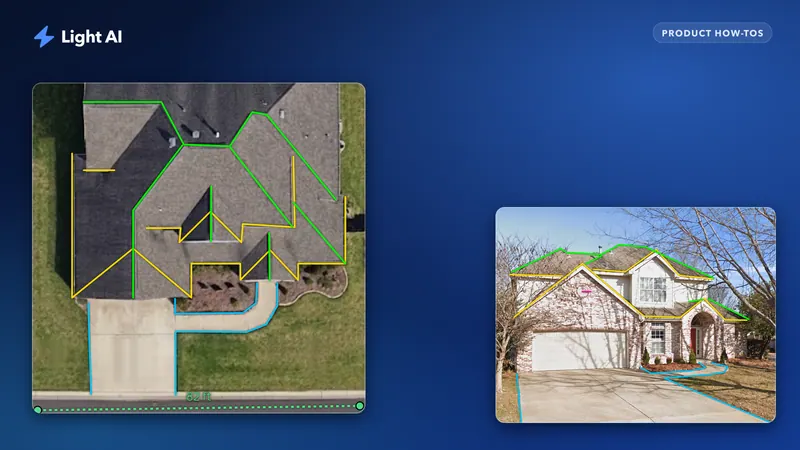
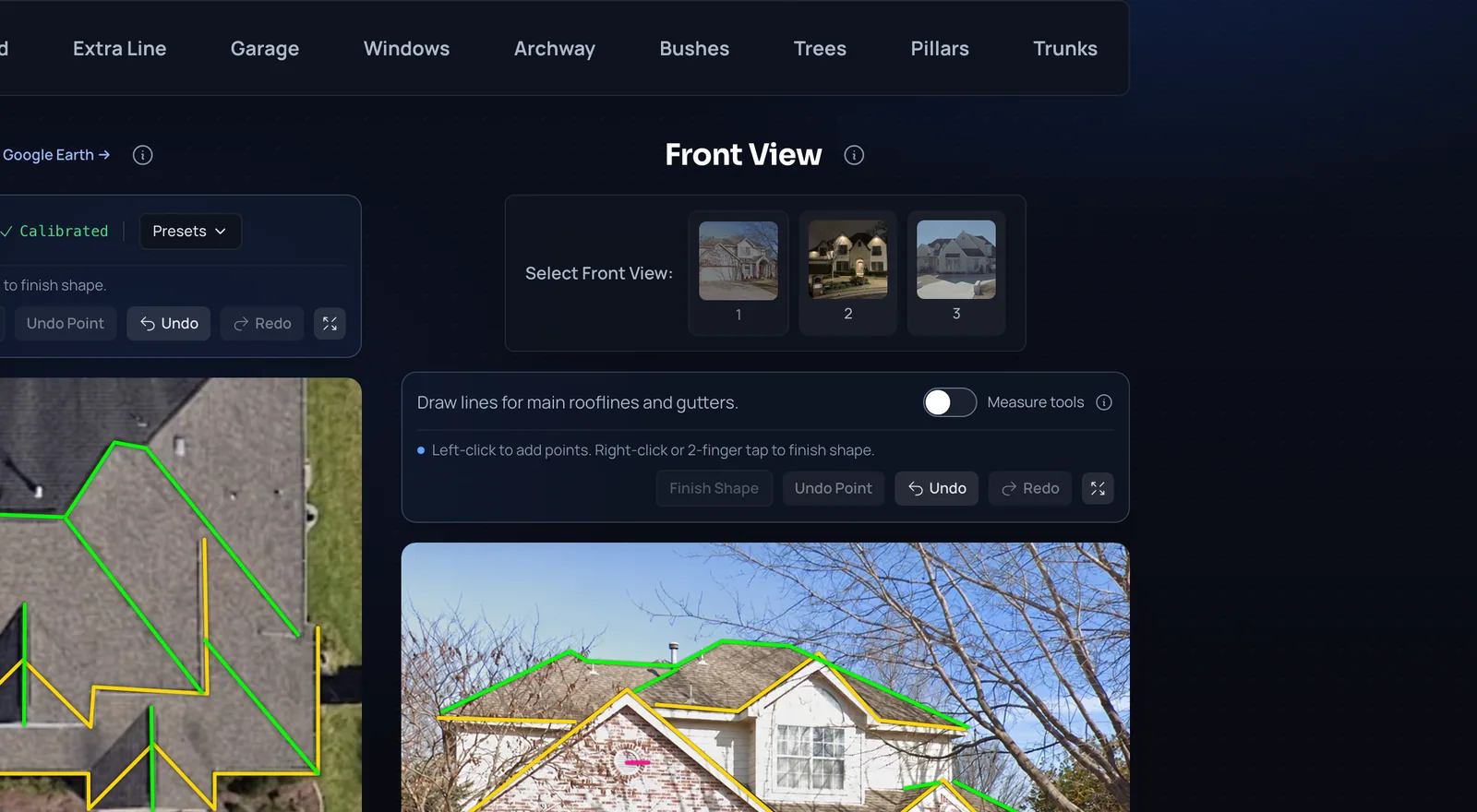
In Light AI the front photo (Street View) and the overhead plan view (satellite) load from the address; you centre the roof, get a to-scale plan view (or upload and calibrate your own screenshot), and trace each run: Starter, Ridges, Ground and so on. Plan measurements become the billed quantities. Measurements support quoting; they are not survey-grade, so verify on site before you hang anything.
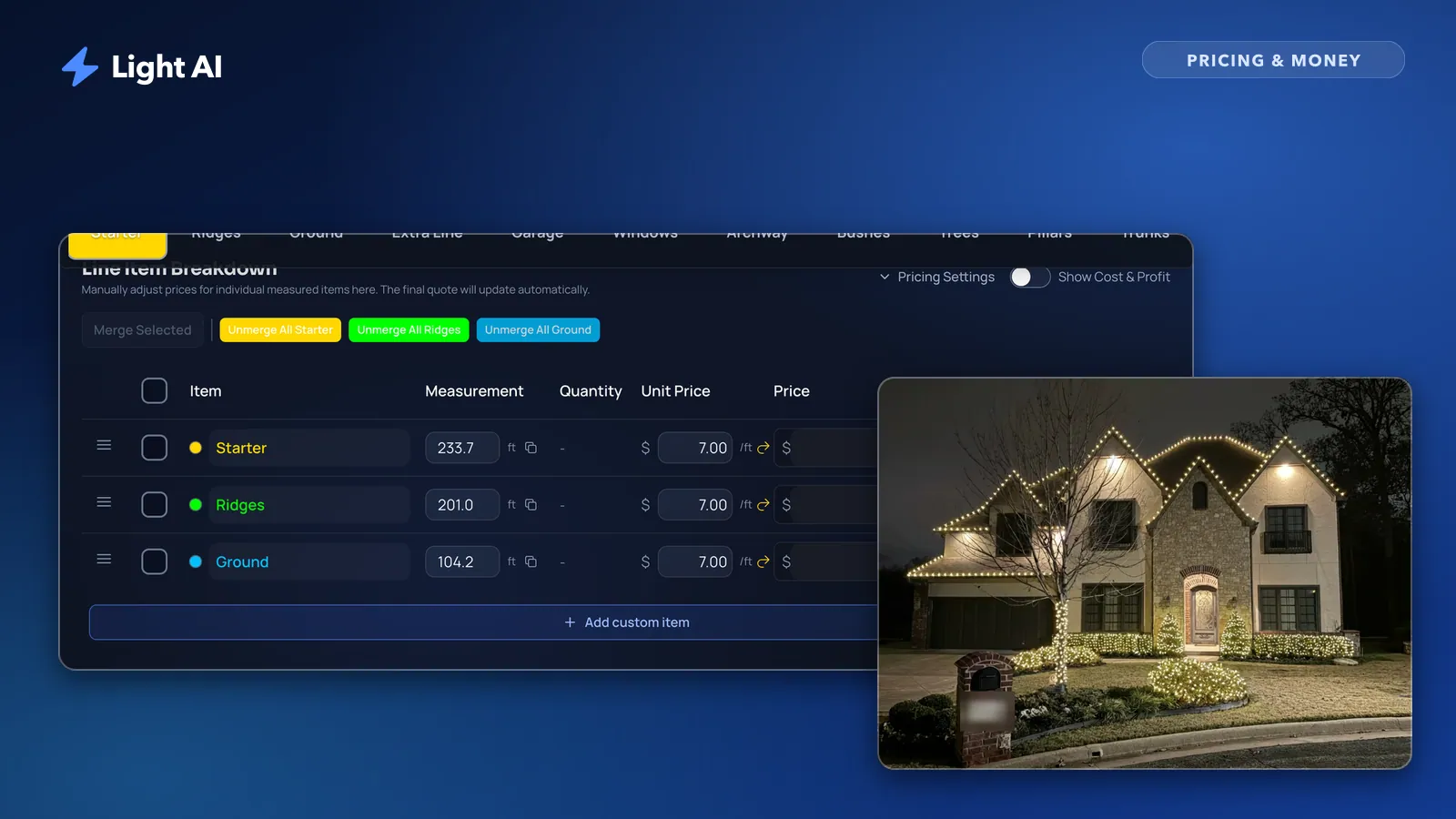
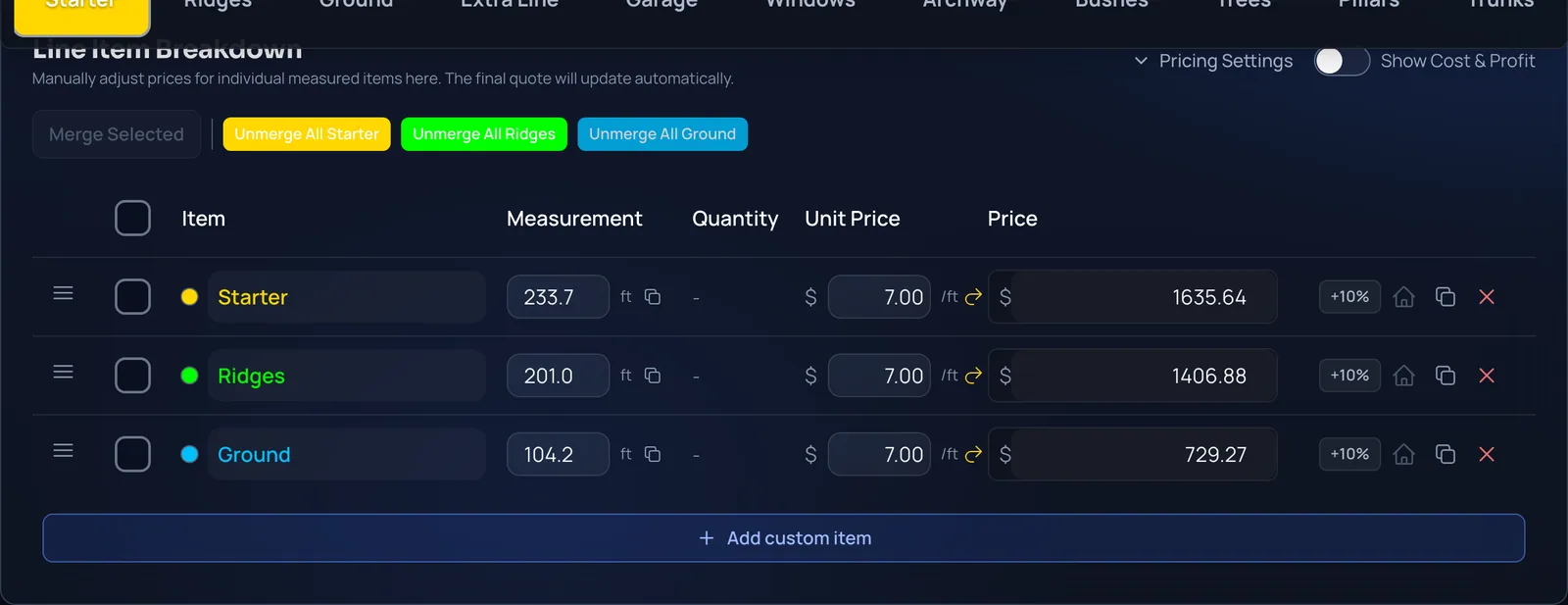
The Line Item Breakdown then lists every run with its measurement and unit price. You can merge rows into one line per category, add a +10% cushion, add custom items for separately priced work, set prices in Pricing Settings and save them to a template so every future quote starts from your rate. Discounts and a deposit line live under Quote Totals. See Calibrating and measuring for the steps.
Let homeowners add extras themselves
Optional extras are an easy way to raise the average ticket without pushing. When you publish a quote link with Approve in Light AI, you can let customers choose optional extras, such as a wreath or a lit walkway, and the total updates on their phone before they approve. More on that in Publishing a customer quote link.
Your pricing checklist before the season
- Calculate your loaded hourly labour cost (wage plus taxes, workers' comp and benefits)
- Time a few real installs and takedowns to get feet per crew hour
- Decide how many seasons you'll reuse lights and spread the cost
- Total your yearly overhead and the feet you expect to sell
- Add reserves for callbacks and bulb replacement
- Choose a target margin and calculate your per-foot rate
- Set a job minimum that covers fixed costs on small houses
- Price trees, bushes, wreaths, timers and power work per piece
- Save your rates to a quote template so every crew member quotes the same way
- Review actual cost per job after the season and adjust
If you also store customers' lights between seasons, read how to price removal and storage. For the timing of all of this across the year, see the season calendar.
Frequently asked questions
How much should I charge per foot for Christmas lights?
There's no single right number. Add your direct cost per foot (lights, clips, labour, takedown, fuel, storage, callbacks), add your overhead share, then divide by one minus your target margin. That gives you a rate that works for your crew and market.
Should I include takedown in my installation price?
Yes, for most residential jobs. Pricing takedown separately invites homeowners to skip it, and you still end up sending a crew. Build takedown labour into the per-foot rate and say clearly in the quote that removal is included.
Is it better to price per foot or per house?
Most contractors calculate per foot and present whichever the homeowner understands best. Per-foot math keeps you profitable on big houses; a per-house or package price is easier to approve. Either way, use a minimum so small jobs still cover their fixed costs.
What's the difference between markup and margin?
Markup is a percentage of your cost; margin is a percentage of your price. A $3 cost marked up 40% sells for $4.20, which is about a 29% margin. Set prices by dividing cost by one minus your target margin.
Can I trust roofline measurements from a photo?
Treat them as a quoting estimate. A calibrated overhead plan view gets you much closer than eyeballing from the street, but measurements are not survey-grade, so confirm on site before ordering or installing.
Quote your next house with Light AI
Measure the roofline, show the homeowner a lighting mockup of their own home and send one quote link they can approve from their phone. Start on the Free plan with 100 credits each month and no card required.